Why Writing a Non-Fiction Book Builds More Authority Than Social Media

By M.K. Ranger – last updated January 12, 2026

It’s tiring to be trapped in a cycle of rented attention. And it’s a risk to your authority.

What’s “rented attention”? You’ve probably heard it a lot lately. Simply put, it’s building your reputation on someone else’s land. When you share your wisdom on platforms like LinkedIn or Substack, you don’t control the rules. You’re "renting" your audience from an algorithm that can change, or bury your best ideas, in an instant.

Does this sound familiar?

  • You have the expertise and the lived experience, but because your wisdom is fragmented across platforms you don’t control, your posts never seem to "stick."

  • You spend hours distilling your unique insights into LinkedIn or Substack posts, only for the algorithm to bury them 24 hours later.

  • You’re building your reputation on rules that are unpredictable, shifting, and mostly unknown.

When your message is scattered across the digital noise, both your posts and your expertise are temporary. To move beyond fleeting visibility, you need to establish a permanent home for your wisdom.

You need a book.

Moving from a "post-to-post" existence to a "book-first" strategy is about creating a single, definitive source for everything you stand for. It’s the difference between shouting in a crowd and owning the stage.

How does writing a book build professional authority?

It’s the shift from creator to author. Going from "content creator" to "published author" is the moment you stop fragmenting your message and start codifying your legacy. It changes your professional trajectory because:

  • Validation over Visibility: When booking a keynote speaker or a consultant, decision-makers don't usually ask "Who has the most followers?" They ask "Who wrote the book on this?"

  • Pricing Authority: Authors command higher fees because their expertise is perceived as "distilled." A book is the ultimate differentiator that signals you’ve done the deep work.

  • The Passive Referral: Unlike a fleeting post, a book is a physical asset. It can be passed from a mentor to a protégé or a CEO to a Board Member, building your reputation in rooms you haven’t even entered yet.

  • Powerful Tool in Job Seeking: A non-fiction book is the ultimate 'Power Move' for a career pivot, transforming a passive resume gap into an active signal of authority that attracts high-level opportunities.

Is Social Media Just "Rented Land" for Your Expertise and Authority?

Social media is designed for the "now.” It offers "snackable" bits of your expertise that naturally lack depth or context. A non-fiction book, however, is a cohesive foundation for authority.

LinkedIn and Substack posts are optimized for immediate engagement, but they are "walled gardens" rarely indexed by search engines. For example, if someone searches for "Leadership curiosity in the boardroom," a high-value post from three months ago is almost impossible to surface in a search engine or an AI conversation.

In contrast, a book is indexed as a permanent intellectual entity. This shifts your wisdom from a fleeting digital signal to a searchable asset, ensuring your expertise remains discoverable by both human searchers and Generative AI models for years to come.

A book offers what social media can’t, and at the very least, these 2 things:

  • Longevity: A book lives in libraries, search engines, and AI training sets for decades.

  • Discoverability: While social posts are rarely indexed by search engines, books are indexed by ISBNs, Amazon, and Google Books, making your wisdom discoverable 24/7.

How Strategic Clarity Turns Your Wisdom into a "Signature System"

One of the greatest benefits of writing a book is the Strategic Clarity it demands. Unlike a 500-word blog post, a book requires you to:

  1. Organize your lived experience into a cohesive framework.

  2. Identify your unique "Signature System" or Proprietary Method.

  3. Distill your message into a clear value proposition.

In layman’s terms: This means moving from "having a lot of ideas" to having one clear, powerful answer to the question: "What is the specific problem I solve, and how do I solve it better than anyone else?"

The "Lighthouse Effect"

If social media is a megaphone in a crowded room, a book is a Lighthouse. It doesn’t scream for attention. It stands still and signals the right people to come to you. Publishing serves as a high-level "Proof of Concept" that opens doors to consulting, freelance work, and media coverage.

The Myth of the "Hard" Path: Why a Book is Actually Easier

You might think: "I don’t have time to write a book." I’m not telling you to stop posting on social media; I’m recommending you use a book as your Source of Truth. A "book-first" strategy helps you stop searching for what to say. Instead, you share from what you’ve already codified:

  • One chapter becomes a month of newsletters.

  • One framework becomes a signature keynote.

  • One page becomes five high-impact social media posts.

A book provides a solid structure that a content calendar simply cannot give you.

Building a Legacy Through Purpose-Driven Writing

For those transitioning from corporate life, a book is a process of remembering who you are. It is the bridge between your lived experience and your professional legacy.

Whether you’re documenting leadership principles like the pivotal role of curiosity in executive success or the resilience you found during a personal transition, you’re doing more than telling a story. You’re providing a strategic roadmap and transforming private wisdom into a lasting public asset.

How Writing a Book Can Accelerate Your Career Transition

If you’re between roles, you know the exhaustion of the "spray and pray" approach to job hunting. Writing a book is the most valuable use of your time and energy during a pivot.

  • Beyond the Resume: A resume tells people what you did; a book shows them how you think.

  • The Interview Edge: Imagine handing over a copy of your book during an executive interview. You’ve shifted the power dynamic from "job seeker" to "subject matter expert."

  • Filling the Identity Gap: Focusing on your book provides a sense of purpose, strength, and clarity.

  • The Permanent Signal: Like a lighthouse, a book is a fixed point of authority that signals your value to the market 24/7. Even when you aren't "active" online or when your posts have vanished from people’s feeds.

  • A Window Into Your Logic/Thinking: It proves you can synthesize complex ideas into a strategic framework or methodology or flow. A skill every team craves.

Common Questions About Building Authority through Non-Fiction

Does a book help with SEO more than a blog?

Yes. While a blog is excellent for short-term traffic, a book is a permanent intellectual asset. It is indexed by major global databases (like Amazon and Google Books), providing a higher level of "Search Authority" over time.

What is the "Lighthouse Effect" in content strategy?

The Lighthouse Effect is a strategic concept that emphasizes building a permanent, high-visibility asset (like a book) to signal your expertise to the right audience. Instead of chasing visibility through a "megaphone" (social media), you establish a fixed point of authority that allows the right opportunities to find you.

Can writing a book help me land an executive role?

Absolutely. A book serves as a proof of concept for your methodology. It moves you from being a "job seeker" to a "subject matter expert," allowing you to lead with your unique Signature System during the interview process.

Summary: The Book as the Anchor of Your Content Strategy

To see how this works in practice, imagine your book as the Hub (the central source of truth for your expertise) and your social media posts as the Spokes (that carry and repeat that message to the world).

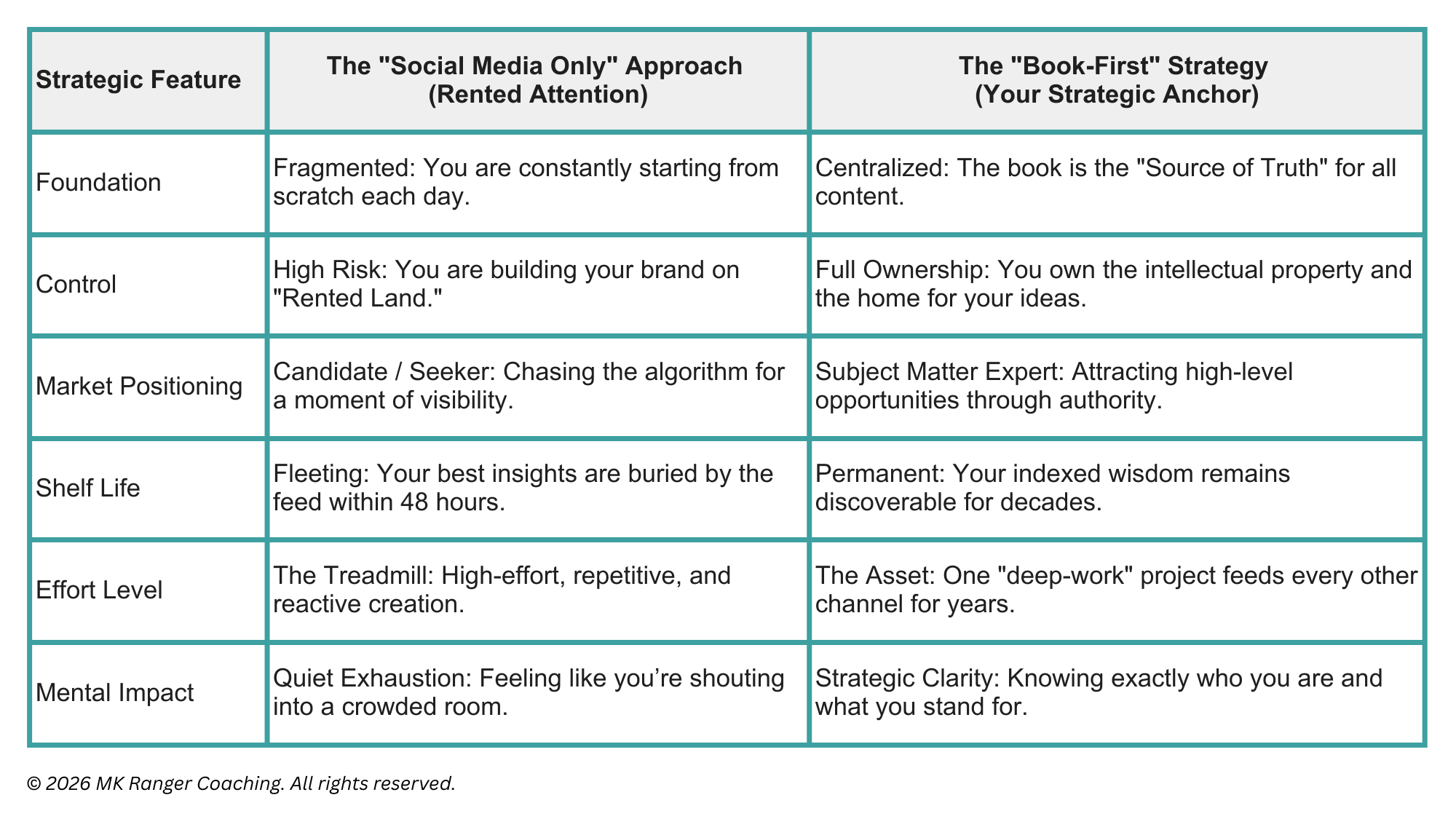
The table below compares the limitations of relying on social media alone versus the leverage of a book-centered strategy.

A strategic comparison table "The Social Media Only Trap vs. The Book-First Strategy" by M.K. Ranger.

Are You Ready to Give Your Wisdom a Permanent Home and Start Writing A Book?

If you’ve been building authority through posts and newsletters, you already have the "raw materials." What you need now is the Strategic Selective Clarity to assemble them.

I help aspiring authors find their voice, their book idea, and navigate the writing and self-publishing journey with confidence. Your expertise deserves more than a 24-hour shelf life.

Your expertise deserves a permanent home.

Click here to learn more about my Non-Fiction Book Coaching services.

Will Writing a Book Cannibalize My High-Ticket Course? (The Truth Every Coach Should Know)

TL;DR: Writing a book won’t replace your $10K coaching program—it actually strengthens it. A book builds trust, widens your audience, and positions you as an authority. Your book is a doorway, not the destination. It can inspire readers to invest in deeper transformation, while giving those who aren’t ready yet a taste of your value. Done right, your book can be your biggest client acquisition tool.

The Common Fear: “If I Write a Book, Will People Still Buy My Program?”

If you’re a coach with a premium program like a $10K transformation package, it’s natural to worry that writing a book could undercut your business.

The objection usually sounds like this:

👉 “Why would anyone pay me thousands if they can get everything in my book for $20?”

It’s a fair question. But it’s also based on a misconception of what books (and courses) actually do for people. Let’s break it down.

1. Books and Courses Serve Different Purposes

A book is designed to inform, inspire, and introduce ideas. It’s a roadmap.

A coaching program is designed to transform. It provides implementation, accountability, personalization, and depth.

Think of it this way: you can buy a cookbook and still hire a chef. The book gives you knowledge, but the chef gives you experience.

2. Books Expand Your Audience Beyond Those Who Could Afford Your Course

Not everyone is ready or financially able to invest in a $10K program. But they might be ready to buy your book!

Your book becomes a low-risk entry point for people to connect with you. Some will stay at the book stage, and that’s okay. Others will move from book → program because now they trust you.

3. A Book Establishes You as the Authority in Your Niche

When someone holds your book in their hands, they don’t just see you as another coach on LinkedIn or Instagram. They see you as an authoritative voice.

Books elevate your credibility.

And credibility drives sales for premium offers.

4. People Don’t Buy Coaching for Information

They buy coaching for:

  • Accountability (someone to keep them on track)

  • Personalization (tailored strategies for their situation)

  • Support (a trusted guide during the hard parts)

  • Transformation (a full shift in identity, not just knowledge)

Your book can’t provide those things, at least not to a great extent. Your coaching program can.

5. A Book Acts as Your Best Marketing Asset

Think of your book as a 24/7 salesperson. It works while you sleep, reaching new people, building your reputation, and priming your ideal clients to take the next step.

A well-written book can be one of the most effective lead generators for coaches because it builds authority, nurtures trust, and attracts the right-fit clients.

6. The People Who Read Your Book Are More Likely to Buy Your Course

Someone who reads your book has already invested time and trust in you.

When they’re ready for more, you’ll be the first person they think of. They’ve already walked part of the journey with you, and they want you as their guide to the finish line.

7. Your Book Filters for the Right Clients

Not everyone is a fit for your high-ticket program. A book lets readers “test drive” your philosophy and teaching style.

The right people will finish your book and say: “I need more of this.” The wrong people will self-select out.

Either way, your book saves you time and energy in the sales process.

8. Your Book Creates Multiple Income Streams

Instead of cannibalizing your high-ticket course, your book could create:

  • Speaking opportunities

  • Podcast invitations

  • Corporate contracts

  • Group program enrollments

  • Digital product upsells

Each of these can funnel people toward your core offer.

9. Books Build Long-Term Legacy and Brand Equity

Courses often evolve or expire. But a book? That’s a permanent footprint in the world.

A book isn’t just about this year’s client pipeline. It’s about the decades-long credibility it gives you.

10. A Book Makes Selling Easier

It might be that before you have a book, sales calls feel like convincing.

After the book, sales calls feel like confirming. Because prospects come pre-sold on your value.

11. The Risk of Not Writing a Book

If you don’t write a book because of fear, you risk:

  • Staying invisible in a crowded coaching market

  • Losing clients to coaches who do publish

  • Missing out on opportunities that your competitors will take

Your book isn’t a threat to your business. Silence is.

12. The Truth: Books and Courses Work Together

Your book should never try to replace your program. Instead, it should:

  • Give people hope and a starting point

  • Share your unique framework

  • Plant seeds that transformation is possible

  • Invite the next step (your course)

When written strategically, a book feeds your coaching practice instead of competing with it.

Your Book is a Bridge, Not a Substitute for Your Course or Your Coaching

Writing a book doesn’t undercut your $10K program—it strengthens it. A book is a trust-building, audience-expanding, authority-anchoring tool that makes your coaching more valuable, not less.

The key is writing your book as a bridge, not a substitute.

So if this fear has been holding you back, let it go. Your book isn’t the end of your coaching journey. It’s the beginning of someone else’s.

 👉 Ready to turn your expertise into a book that grows your impact and your business? Let’s talk. Explore my book coaching services here.

25 Reasons To Start Your Own Business, Even In Midlife

25 reasons to start your business in midlife

Do you constantly have the Sunday Scaries? Monday Mayhem? 😱

There are other ways to earn an income that doesn’t involve languishing in a soul-sucking 9 to 5 job.

Here are 25 reasons for starting your own business in midlife:

  1. You want to do work you love.

  2. You want to live more authentically.

  3. You want to design your work around your lifestyle.

  4. You want to work from any location or country you choose.

  5. You want to spend more time with family, friends, pets, or hobbies.

  6. You want to do something you’re passionate about.

  7. You want autonomy in your work.

  8. You want to do work that doesn't feel like work.

  9. You want to be happier doing something that matters to you.

  10. You want the flexibility to choose who you work with.

  11. You want to spend your days positively impacting people’s lives.

  12. You want to retire earlier than 65.

  13. Your 9 to 5 job doesn’t meet your financial goals.

  14. You want to escape from a fixed income and have control over your income.

  15. You want to pursue the dreams you’ve put on hold for so long.

  16. You want to adapt your work to fit your life circumstances.

  17. You want to do work that better aligns with your values and beliefs.

  18. You’re tired of living other people’s expectations.

  19. You realize that you hate your 9 to 5 job and that it no longer serves you..

  20. You want to fulfill your passion and your purpose.

  21. You want to do something in retirement that generates income and brings joy.

  22. You want a creative outlet for self-expression and innovation.

  23. You realize that you can monetize decades of accumulated knowledge.

  24. You’re tired of endless meetings and the 9 to 5 grind.

  25. You want to leave a legacy.

Some of my own reasons are included in the above list.

❓ Do YOU want to start a business? What's stopping you?

I run 3 part-time businesses outside of my 9 to 5 hours - freelance writing, personal development coaching for entrepreneurs, and photography - sometimes during early mornings, sometimes evenings, sometimes weekends, and sometimes all three! And I started them when I was a single mum.

Get in touch with me if you want some help.

𝙔𝙤𝙪'𝙫𝙚 𝙜𝙤𝙩 𝙬𝙝𝙖𝙩 𝙞𝙩 𝙩𝙖𝙠𝙚𝙨. 𝙄𝙩 𝙄𝙎 𝙥𝙤𝙨𝙨𝙞𝙗𝙡𝙚.

To your mission, vision, and passion,

Mary Kay xoxo 💙


The Key to Confidence: Your Beliefs

Do you ever feel like you’re stuck in a loop of self-doubt, unable to break free? Are you tired of watching opportunities slip by because you lack the confidence to grab them? What if I told you that the key to unlocking confidence lies in understanding how your beliefs play an important role? Let’s dive into how your beliefs could be keeping you stuck.

What is confidence anyway?

Confidence is like having a secret power that fuels you to take on challenges, try new things, and to bounce back when life throws you a curveball.  It’s that voice inside saying “You got this.”  It’s the unwavering belief in your capabilities. Without it, doubt and uncertainty can creep in causing you to hesitate and procrastinate. It can even impact your overall well-being and lead to stress and anxiety. Confidence is the cornerstone of your personal and professional growth, empowering you to become the best version of yourself.

How do beliefs impact your confidence?

Imagine your beliefs as the soil for growing the tree that is your confidence. Just like nutrient-rich soil gives life to your tree, your beliefs about yourself feed the roots of your confidence. Your beliefs shape how you see yourself and your sense of worth.

As humans, we take actions based on what we believe about ourselves. When you’re an entrepreneur, if you believe you’re not good enough, you’ll shy away from opportunities that might have propelled your business forward. These could be things like going to a networking event, writing an article, or accepting a speaking engagement.

The Connection between your brain and beliefs

How about some brain science on this? We know that your brain creates neural connections based on your thoughts and experiences. This is the physical aspect of your beliefs. You may have heard of the popular neuroscience phrase, thanks to Dr. Donald Hebb, “Neurons that fire together wire together.”

Think of your brain’s pathways as train tracks. If you’ve laid the tracks for self-doubt through consistently thinking you’re not good enough, then your thought train will by default travel down that track.  But when you repeatedly think that you have the skills (or can learn them) or that you can do the things that you want to do, you are physically wiring your brain to reinforce your positive self-view.

“The brain is a learning machine. When two neurons activate together or start talking to each other, the connection between them strengthens. Then, they’re more likely to have that same conversation again in the future.” - Minnesota Neuropsychology

Cultivating positive beliefs

The beauty of beliefs is that you have the power to shape them. Remember your tree of confidence? You can nurture its growth by tending to the soil around it. Thoughts are the building blocks of beliefs. If you can change your thoughts, then you can create new beliefs.

There are so many ways to cultivate positive beliefs! While I won’t get into all the techniques here, I’ll give you some easy ones.

Awareness. Start by becoming aware of your self-talk. Those little whispers of doubt or criticism? Practice noticing them. When you start noticing them, then you can challenge them. Is that thought really true?  If you find yourself thinking “I can’t do this,” you can then explore why you think you can’t do the thing and recycle that thought with something empowering like “I have the skills to do this” or “I am capable of learning.”

Evidence. Once you can come up with a better thought, look for evidence to support it. Here are a few ways to shop for evidence:

  • Try thinking back to times in your life when you've overcome challenges or achieved successes.

  • Research and gather real-life examples of individuals who have successfully embodied the belief you're trying to install. Read success stories, watch interviews, or listen to podcasts where people share their experiences related to this belief.

  • Think about those times when someone patted you on the back, gave you a thumbs up, or said, 'Hey, great job!' It could have been about something close to the new thought you're aiming for. Positive feedback from others serves as external validation of your capabilities, reminding you that you’ve got what it takes.

Environment. You can also seek out environments (and people) that encourage growth and learning. When I started losing confidence in myself back in 2021, I joined Clubhouse, a social audio app, to find other life coaches and inspiration. I was quickly surrounded by positive people who uplifted and supported me. They also challenged me by inviting me to participate in their discussion rooms. It didn’t take long for me to regain my confidence in public speaking by renewing my belief that I was good enough.

The more you immerse yourself in positive experiences, the more your beliefs about your abilities and worth will flourish.

Confidence isn’t something you’re born with

Confidence isn't something reserved for a lucky few at birth; it's a mindset created and nurtured by the foundation of your beliefs. By understanding the link between beliefs and confidence, you gain a superpower in decision-making. Positive beliefs about your skills and business can lead to bolder choices and drive growth. Picture this: Your choices become bolder, and challenges start to look like opportunities.

Harness the power of your beliefs to build your confidence and propel your business forward.

Keep going. You got this. 💙


7 Bricks in the Road To Building Self-Confidence

Managing insecurity, one action at a time

A bloody nose. A typical school day. My “new kid” appeal hadn’t faded yet and neither had my accent. Born in London, England, my family immigrated to Toronto, Canada the year before and right after my 6th birthday. In the early 1970s, Toronto’s multiculturalism did not exist yet. My voice, my frizzy hair and chubby physique painted a bullseye on my forehead. On this particular day, I was marked by the humidity, inflating my curls into a jab-worthy mess.

Andrea (not her real name) was the lead bully, and would regularly push, punch and pinch me whenever the mood struck her. She would enlist the rest of the Grade 2 army to hurl insults. Worse though, was Andrea catching me alone in the school bathroom to endure multiple pinching and taunting.

I never reported Andrea or any of the other incidents. I never told my parents. As new immigrants, I decided that they had enough on their plates. Had I known the future impact of maintaining the silence, my decisions may have been different. Fortunately, my childhood home was a safe and happy place where I could shed my school day and lose myself in books about faraway places with princes on white horses.

I spent the rest of my primary school years nourishing the seeds of my insecurity. I learned to extinguish my British accent. I learned how to straighten my hair each morning after my parents left for work. This was a daunting process, involving a clothing iron, a blow dryer and six empty soup cans. Good fortune struck when a new television show called Charlie’s Angels dominated the ratings and Farrah Fawcett, with her signature hairstyle, released me from my daily strand-taming ritual.

Enough Patches to Make a Quilt

I escaped Andrea and my other tormentors when my family moved away a few years later. But, by the time we moved, the effects were already part of my fabric and travelled with me to our new home. You see, I had already manufactured my own Frankenstein (thanks Mary Shelley), stitching the past events together and upcycling them to create a quilted ally. This ally would serve as my trusted companion and chauffeur: Insecurity.

My creation wrapped itself around every aspect of my life. I learned to choose safety and the path of least resistance every time. I learned to melt into the crowd. My internalized bully was remarkably reliable. Whenever I faced rejection, I could count on Insecurity to support the result by reminding me that I wasn’t good enough anyway.

The Seeds You Water Will Grow

As a child, I wasn’t able to see my options for managing my situation and this didn’t change in my early adulthood. Looking back to my early twenties, I could have chosen to put energy into nourishing my self-esteem. I could have sought counselling. I could have searched for ways to heal. I could have declared the unacceptable. For the first four decades of my life, I watered the seeds that allowed me to sprout in the crop field with everyone else. I didn’t realize that life had other farms and different crops!

One great example of the power of choices is Paul Nadeau, author of the book Take Control of Your Life, an impressive example of declaring the unacceptable, despite the environment of his childhood. He describes suffering at the hands of his abusive father and then employing that trauma to choose a different path. He decided at a young age what he wanted to be when he grew up: a police officer so that he could arrest people like his father. Paul went on to dedicate his life to serve and protect others and became a decorated police detective, hostage negotiator and international peacekeeper, and continues his service by inspiring others as an author and a sought after motivational speaker.

Consciously Uncoupling

In 2007, I was about to turn the Big Four-Oh, become a divorce statistic, and change careers all within weeks. As my big milestones approached, I chose to seek counselling for the first time in my life.

Part of the therapy involved evaluating my life. My evaluation confirmed that I had done “meh” really well and earned a PhD in Mediocrity. I began asking myself some typical mid-life questions: Would anyone (other than my family) miss me if I was gone? What would I be remembered for?

I arrived at the question: Who had written my life’s first chapter? Have you ever wondered this? I suddenly realized that it was I who held the pen. That and my Frankenstein was the editor. I needed to consciously uncouple from this as well. This term was created by Kathryn Woodward Thomas, a marriage therapist and refers to a process which strives for an amicable divorce. I didn’t want to live another 40 years of humdrum. I reasoned that if I could leave my marriage and my career, then I could uncouple from insecurity as well. I sought comfort in this logic.

You’re Fired!

I committed to writing my life’s Chapter 2 without my internal editor and began to regularly call Insecurity into the arena to fight for the pen. Whenever she announced “You can’t do that!”, I would joust with “Watch me”. We tangled and sometimes Insecurity won. But, not every time. The more I challenged her, the weaker she became. It felt so good to rebel. Eventually, I fired my internal editor.

And Now, the Bricks!

There were many more defining moments where I banished my bully and pressed on. The decisions made during those times accelerated my personal and professional successes beyond anything resembling a vanilla existence. Each small step I took was a brick that paved the road to self-confidence. What follows is a description of those bricks.

Self-Confidence is a Skill

“The expert at anything was once a beginner.”

— Helen Hayes

Confidence is a skill and that means it can be learned and mastered. As my confidence seedlings began to sprout, so did my desire to stop hiding in the crowd. Others around me began taking notice. Colleagues approached me to ask for coaching and I wanted to help. So, I reverse-engineered what I had practiced and began to share it with others.

1. Test your rejection resilience — Canadian Jason Comely created a self-help game called Rejection Therapy to take the sting out of being rejected through controlled exposure. Take tiny steps to confirm that you can withstand rejection. The object is to be rejected by at least one person a day. This can include things like asking someone if you can cut in line in front of them, buying a lottery ticket, asking for discounts at the grocery store, and any other small ways to ensure you get a rejection. Over time, this gives you a proven track record of overcoming rejection!

2. Be your own cheerleader — Remind yourself daily that you are enough. Set a reminder in your phone to read the words “I AM ENOUGH”. Celebrate all of your accomplishments, even the small ones.

3. Watch for your Frankenstein — Be vigilant for insecure thoughts. Make an effort to notice your thoughts and evaluate them as either helpful or not helpful. If they are not helpful, imagine closing a door on them.

4. Do something for someone else — This can help you to be more confident in your abilities. It doesn’t need to be a grand gesture. Call a friend that is struggling and check in on them. Offer to shovel your neighbour’s driveway. Helping others activates the reward centres in our brain and shows us that we can positively impact someone else’s life.

5. Take a small step toward one of your goals — Each accomplishment will not only get you closer to your goals, but it will also feed your self-esteem by acting as evidence that you are good enough.

6. Treat your internal bully like a toddler — This one is fun! Visualize your Frankenstein as if they are a small child. Then, imagine putting them in a Time-Out chair. Ask them to sit quietly and wait for you while you do the thing you are anxious and insecure about. This helped me when I first started public speaking.

7. Find mentors — If your internal bully is your anti-mentor, then find others who can mentor you. They can help you boost your confidence in your abilities by providing feedback and helping you grow. Approach people online and cultivate a relationship. The worst that can happen is that they ignore you or say no. More Rejection therapy!

“Although our fears and limiting beliefs won’t completely disappear, over time they lose their power over our daily thoughts and actions.” Bonnie Marcus, Forbes

Final Thoughts

Just like any skill, your self-confidence is built through practice. Think of it as a muscle-building exercise. Each small step you take will lead you to take bigger steps later. How many reps do you need? As many as it takes!

My insecurities still get triggered from time to time, but that once-reliable voice no longer drives my decisions nor edits my story.

If your internal bully fights for your mind’s steering wheel, tell them to go hang out with mine. There are enough Time-Out chairs for all of them.

Keep going.

💙

(originally published by The Innovation in Medium.com)