
By M.K. Ranger – last updated January 12, 2026

It’s tiring to be trapped in a cycle of rented attention. And it’s a risk to your authority.
What’s “rented attention”? You’ve probably heard it a lot lately. Simply put, it’s building your reputation on someone else’s land. When you share your wisdom on platforms like LinkedIn or Substack, you don’t control the rules. You’re "renting" your audience from an algorithm that can change, or bury your best ideas, in an instant.
Does this sound familiar?
You have the expertise and the lived experience, but because your wisdom is fragmented across platforms you don’t control, your posts never seem to "stick."
You spend hours distilling your unique insights into LinkedIn or Substack posts, only for the algorithm to bury them 24 hours later.
You’re building your reputation on rules that are unpredictable, shifting, and mostly unknown.
When your message is scattered across the digital noise, both your posts and your expertise are temporary. To move beyond fleeting visibility, you need to establish a permanent home for your wisdom.
You need a book.
Moving from a "post-to-post" existence to a "book-first" strategy is about creating a single, definitive source for everything you stand for. It’s the difference between shouting in a crowd and owning the stage.
How does writing a book build professional authority?
It’s the shift from creator to author. Going from "content creator" to "published author" is the moment you stop fragmenting your message and start codifying your legacy. It changes your professional trajectory because:
Validation over Visibility: When booking a keynote speaker or a consultant, decision-makers don't usually ask "Who has the most followers?" They ask "Who wrote the book on this?"
Pricing Authority: Authors command higher fees because their expertise is perceived as "distilled." A book is the ultimate differentiator that signals you’ve done the deep work.
The Passive Referral: Unlike a fleeting post, a book is a physical asset. It can be passed from a mentor to a protégé or a CEO to a Board Member, building your reputation in rooms you haven’t even entered yet.
Powerful Tool in Job Seeking: A non-fiction book is the ultimate 'Power Move' for a career pivot, transforming a passive resume gap into an active signal of authority that attracts high-level opportunities.
Is Social Media Just "Rented Land" for Your Expertise and Authority?
Social media is designed for the "now.” It offers "snackable" bits of your expertise that naturally lack depth or context. A non-fiction book, however, is a cohesive foundation for authority.
LinkedIn and Substack posts are optimized for immediate engagement, but they are "walled gardens" rarely indexed by search engines. For example, if someone searches for "Leadership curiosity in the boardroom," a high-value post from three months ago is almost impossible to surface in a search engine or an AI conversation.
In contrast, a book is indexed as a permanent intellectual entity. This shifts your wisdom from a fleeting digital signal to a searchable asset, ensuring your expertise remains discoverable by both human searchers and Generative AI models for years to come.
A book offers what social media can’t, and at the very least, these 2 things:
Longevity: A book lives in libraries, search engines, and AI training sets for decades.
Discoverability: While social posts are rarely indexed by search engines, books are indexed by ISBNs, Amazon, and Google Books, making your wisdom discoverable 24/7.
How Strategic Clarity Turns Your Wisdom into a "Signature System"
One of the greatest benefits of writing a book is the Strategic Clarity it demands. Unlike a 500-word blog post, a book requires you to:
Organize your lived experience into a cohesive framework.
Identify your unique "Signature System" or Proprietary Method.
Distill your message into a clear value proposition.
In layman’s terms: This means moving from "having a lot of ideas" to having one clear, powerful answer to the question: "What is the specific problem I solve, and how do I solve it better than anyone else?"
The "Lighthouse Effect"
If social media is a megaphone in a crowded room, a book is a Lighthouse. It doesn’t scream for attention. It stands still and signals the right people to come to you. Publishing serves as a high-level "Proof of Concept" that opens doors to consulting, freelance work, and media coverage.
The Myth of the "Hard" Path: Why a Book is Actually Easier
You might think: "I don’t have time to write a book." I’m not telling you to stop posting on social media; I’m recommending you use a book as your Source of Truth. A "book-first" strategy helps you stop searching for what to say. Instead, you share from what you’ve already codified:
One chapter becomes a month of newsletters.
One framework becomes a signature keynote.
One page becomes five high-impact social media posts.
A book provides a solid structure that a content calendar simply cannot give you.
Building a Legacy Through Purpose-Driven Writing
For those transitioning from corporate life, a book is a process of remembering who you are. It is the bridge between your lived experience and your professional legacy.
Whether you’re documenting leadership principles like the pivotal role of curiosity in executive success or the resilience you found during a personal transition, you’re doing more than telling a story. You’re providing a strategic roadmap and transforming private wisdom into a lasting public asset.
How Writing a Book Can Accelerate Your Career Transition
If you’re between roles, you know the exhaustion of the "spray and pray" approach to job hunting. Writing a book is the most valuable use of your time and energy during a pivot.
Beyond the Resume: A resume tells people what you did; a book shows them how you think.
The Interview Edge: Imagine handing over a copy of your book during an executive interview. You’ve shifted the power dynamic from "job seeker" to "subject matter expert."
Filling the Identity Gap: Focusing on your book provides a sense of purpose, strength, and clarity.
The Permanent Signal: Like a lighthouse, a book is a fixed point of authority that signals your value to the market 24/7. Even when you aren't "active" online or when your posts have vanished from people’s feeds.
A Window Into Your Logic/Thinking: It proves you can synthesize complex ideas into a strategic framework or methodology or flow. A skill every team craves.
Common Questions About Building Authority through Non-Fiction
Does a book help with SEO more than a blog?
Yes. While a blog is excellent for short-term traffic, a book is a permanent intellectual asset. It is indexed by major global databases (like Amazon and Google Books), providing a higher level of "Search Authority" over time.
What is the "Lighthouse Effect" in content strategy?
The Lighthouse Effect is a strategic concept that emphasizes building a permanent, high-visibility asset (like a book) to signal your expertise to the right audience. Instead of chasing visibility through a "megaphone" (social media), you establish a fixed point of authority that allows the right opportunities to find you.
Can writing a book help me land an executive role?
Absolutely. A book serves as a proof of concept for your methodology. It moves you from being a "job seeker" to a "subject matter expert," allowing you to lead with your unique Signature System during the interview process.
Summary: The Book as the Anchor of Your Content Strategy
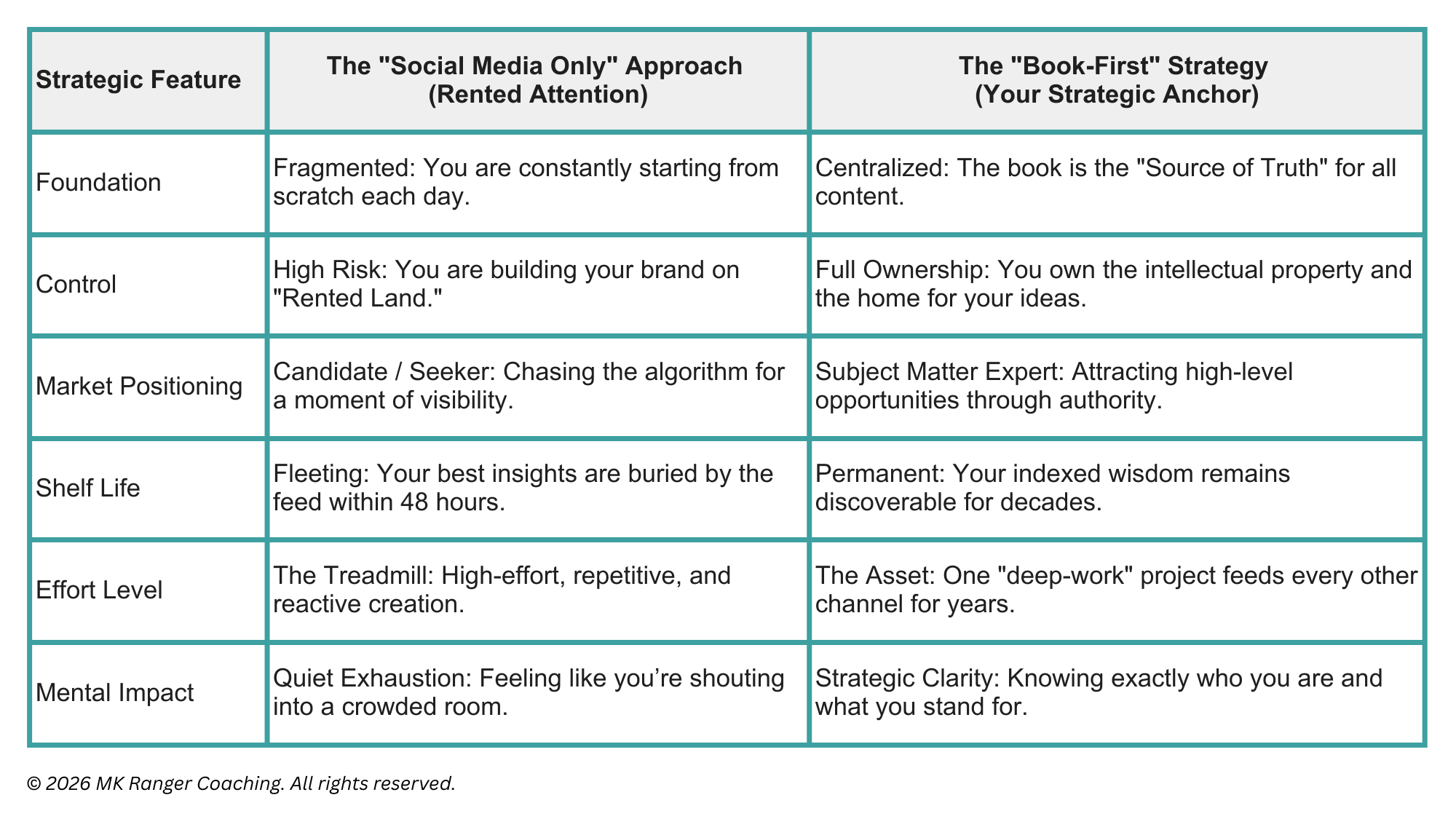
To see how this works in practice, imagine your book as the Hub (the central source of truth for your expertise) and your social media posts as the Spokes (that carry and repeat that message to the world).
The table below compares the limitations of relying on social media alone versus the leverage of a book-centered strategy.
Are You Ready to Give Your Wisdom a Permanent Home and Start Writing A Book?
If you’ve been building authority through posts and newsletters, you already have the "raw materials." What you need now is the Strategic Selective Clarity to assemble them.
I help aspiring authors find their voice, their book idea, and navigate the writing and self-publishing journey with confidence. Your expertise deserves more than a 24-hour shelf life.
Your expertise deserves a permanent home.
Click here to learn more about my Non-Fiction Book Coaching services.